Why Does Pitot-Static Testing Take So Long? Rethinking the Portable Air Data Test Set
What makes air data testing so equipment-heavy?
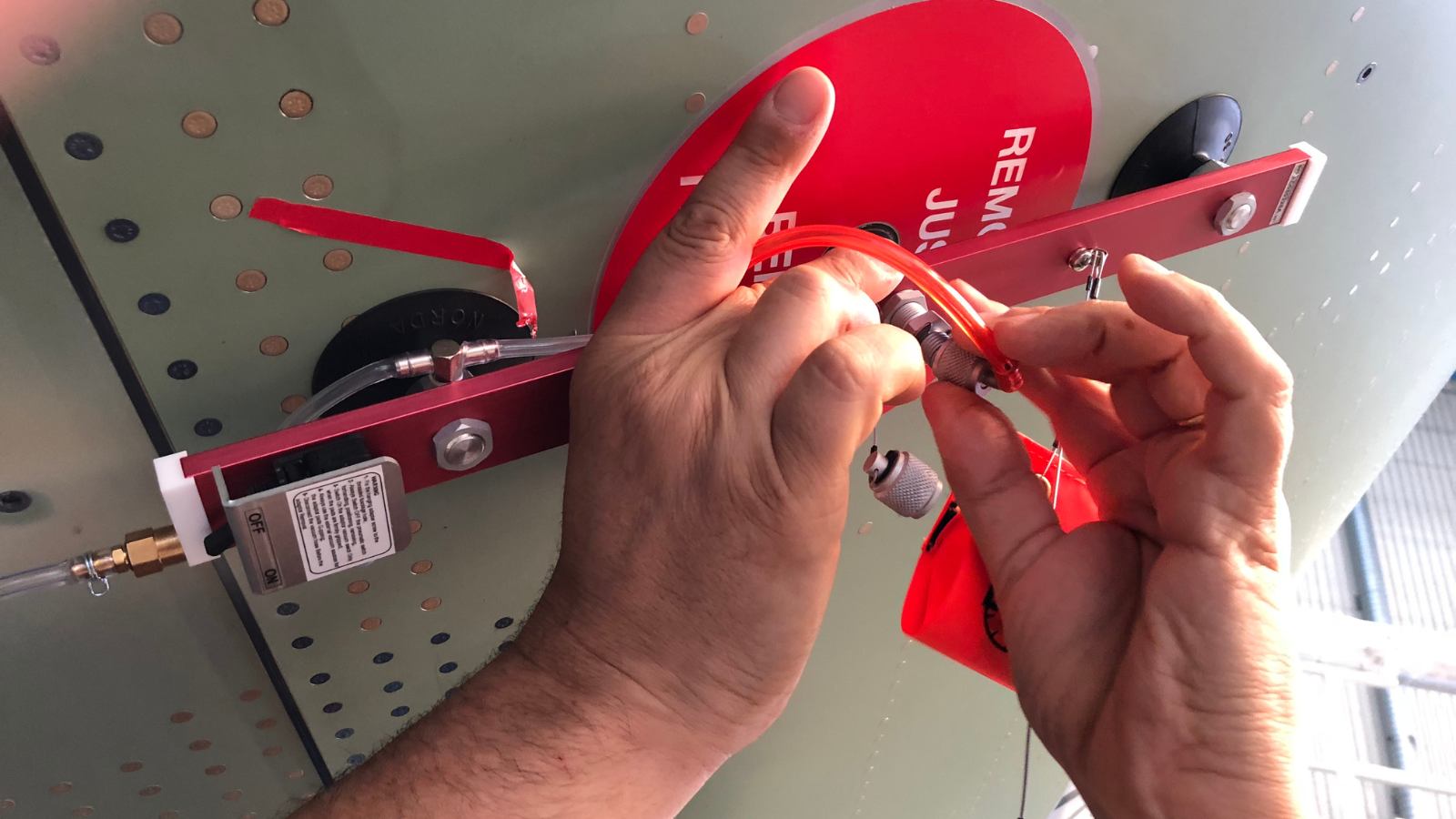
Ask any avionics technician where the time goes on a pitot-static check, and the answer is rarely the test itself. The time goes into everything around it: finding the right cart, loading the test set, tracking down the separate vacuum source for the adapters, running hoses, finding power, and reconnecting lines as the job moves from port to port. On a busy hangar floor or at a remote line station, that setup can take as long as the test.
For fleet operators and MRO directors, those minutes add up across every aircraft, every inspection interval, and every location. The equipment you choose shapes how much of a technician's day is spent testing and how much is spent hauling and connecting.
What makes air data testing so equipment-heavy?
Short answer: Traditional pitot-static test equipment often depends on several separate pieces working together, and each one adds weight, cables, and setup steps.
A typical air data testing setup can include the test set itself, a separate vacuum unit to hold suction-cup adapters to the fuselage, multiple hoses and fittings, power cords, and in some cases a remote control or wireless module sold as a separate option. Each component has to be transported, connected, checked, and packed up again.
On aircraft with multiple static and pitot ports, technicians may disconnect and reconnect lines several times during a single test. Every connection is another chance for a leak, another minute of troubleshooting, and another item to account for before the aircraft is released.
What should maintenance teams look for in a portable Air Data Test Set?
Short answer: Look for a self-contained unit that meets RVSM accuracy requirements, runs on flexible power, and reduces the number of separate pieces your team has to carry and connect.
The most useful questions to ask when evaluating a portable Air Data Test Set are practical ones:
- Are the pumps built in, or does the unit depend on an external supply?
- Does it provide its own vacuum source for fuselage adapters?
- Can it run on battery, AC, and aircraft DC power?
- Can a technician control it wirelessly without buying an add-on?
- Does it meet RVSM accuracy requirements across the full altitude range your fleet flies?
The fewer "no" answers, the less your team carries to every aircraft.
How does the DMA MPS63 reduce setup and transport time?
Short answer: The MPS63 puts the pumps, vacuum source, battery, touchscreen, and Wi-Fi into a single 5 kg (11 lb) case with a stowable handle.
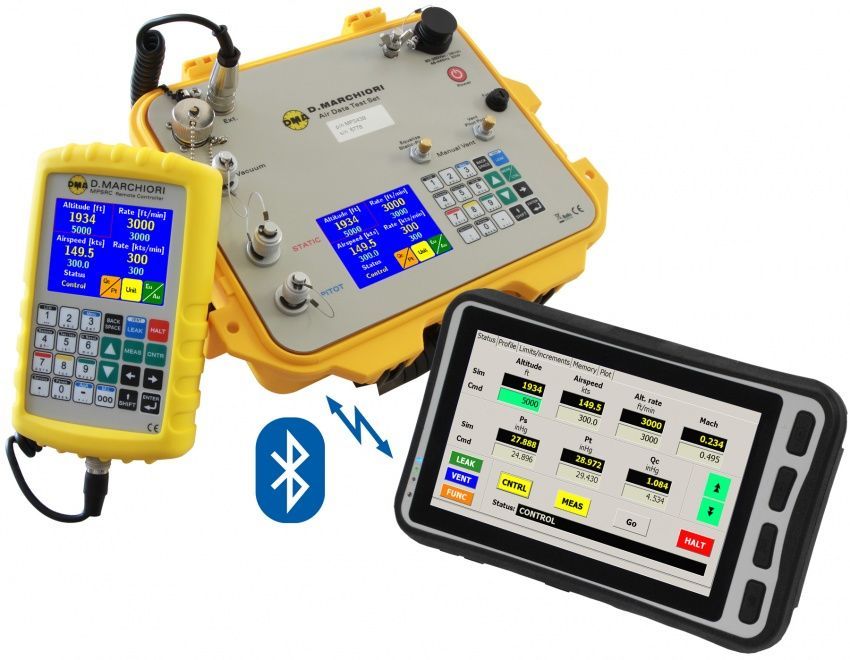
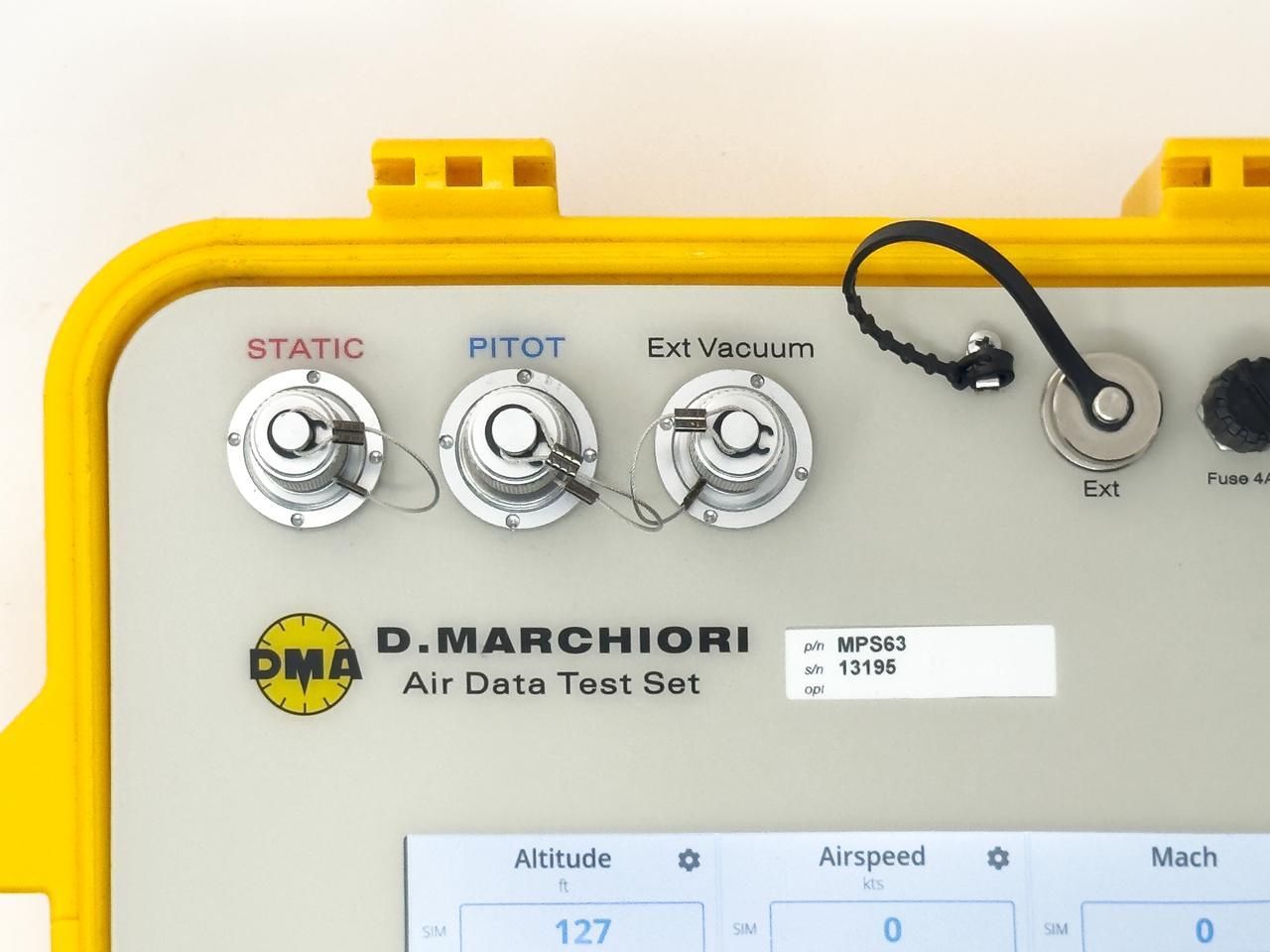
The DMA MPS63 was designed around the reality of flight line and hangar work. Its integrated pumps and a dedicated front panel vacuum port power DMA suction-cup adapters directly, removing the need for a separate vacuum box. Built-in Wi-Fi allows a technician to control the test from an iPad while moving between the cockpit and the aircraft exterior, without an add-on module.
The unit measures 11.8 x 9.8 x 4.7 inches, small enough to carry by hand between aircraft, hangars, or line stations. An internal battery supports two hours of operation, and the MPS63 also runs on universal AC power or 28VDC, so technicians can work where the aircraft is parked.
For aircraft with multiple ports, an optional external manifold adds three additional static and pitot ports for a 4x4 configuration, reducing the number of times lines need to be moved during a test.
[Image: MPS63 touchscreen interface from the DMA datasheet. Alt text: "MPS63 touchscreen display showing simultaneous altitude, airspeed, Mach, and rate readings"]
Does a smaller test set compromise RVSM accuracy?
Short answer: No. The MPS63 is accurate to ±3 feet at sea level and meets RVSM calibration requirements.
Portability only matters if the data holds up. The MPS63 uses temperature- and pressure-compensated sensing to maintain accuracy across its range: ±3 feet at sea level, ±7 feet at 30,000 feet, and ±18 feet at 50,000 feet. Airspeed testing extends from 10 to 700 knots, which broadens the range of aircraft a single unit can support.
Commanded and measured values are displayed together on a 7-inch touchscreen, so technicians can confirm results without switching screens. Calibration runs on a one-year interval and is performed through software.
How is the MPS63 different from the MPS43B?
Short answer: The MPS63 is the successor to the MPS43B and adds a larger touchscreen, integrated Wi-Fi, double the battery life, and a higher airspeed range.
Operators familiar with the MPS43B will recognize the rugged, splashproof design. The MPS63 builds on it with several upgrades:
- Airspeed capability increased to 700 knots, up from 550 knots
- Integrated Wi-Fi, replacing the separate wireless option
- Two-hour internal battery, twice the operating time of the MPS43B
- A large integrated touchscreen with a modernized interface
- A hermetically sealed power button for improved moisture resistance
Why does portability matter differently for fleet operators and MROs?
Short answer: Fleet operators gain flexibility across locations, while MROs gain throughput on the hangar floor.
For fleet operators and flight departments, one test set often supports aircraft at multiple bases or travels with the aircraft. A compact, self-contained unit makes it realistic to perform checks where the aircraft is, rather than scheduling around where the equipment is.
For MRO directors, the benefit shows up in turnaround. Less time spent staging equipment and managing connections means technicians can move from one aircraft to the next faster, with fewer setup variables affecting the result.
How does the MPS63 protect aircraft instruments during testing?
Short answer: Built-in safety limits, automatic protection against damaging pressure conditions, and circuit isolation during power loss.
The MPS63 prevents static pressure from exceeding pitot pressure, a condition that can damage instruments. Technicians can set altitude, airspeed, and climb or descent rate limits, and intelligent software blocks inputs outside those ranges. If power is lost, the test circuit is safely isolated. An automatic leak check and controlled venting to ambient are standard.
Frequently Asked Questions
What is a portable Air Data Test Set?
A portable Air Data Test Set simulates altitude and airspeed by controlling static and pitot pressure, allowing technicians to test and calibrate an aircraft's air data instruments on the flight line or in the hangar.
How much does the MPS63 weigh?
The MPS63 weighs 5 kg (11 lbs), including its internal pumps and battery.
Does the MPS63 require a separate vacuum source for adapters?
No. A built-in front panel vacuum port powers DMA suction-cup adapters directly.
Can the MPS63 be controlled wirelessly?
Yes. Integrated Wi-Fi allows control from an iPad, and an optional wired remote is also available.
Is the MPS63 RVSM compliant?
Yes. With ±3 feet accuracy at sea level, the MPS63 meets RVSM calibration requirements.
Who sells and services the MPS63 in the Americas?
Texas Aerospace Technologies is the exclusive sales and service center for DMA in North and South America.
Learn More
Texas Aerospace Technologies is the exclusive sales and service center for DMA across North and South America, supporting operators and MROs with product guidance, calibration, and service. Explore the full specifications on the
MPS63 product page
or contact our team at sales@txaero.com.